

0
Items
$0.00
We don't sell. We educate.
Weekly science about sex, delivered to your inbox.
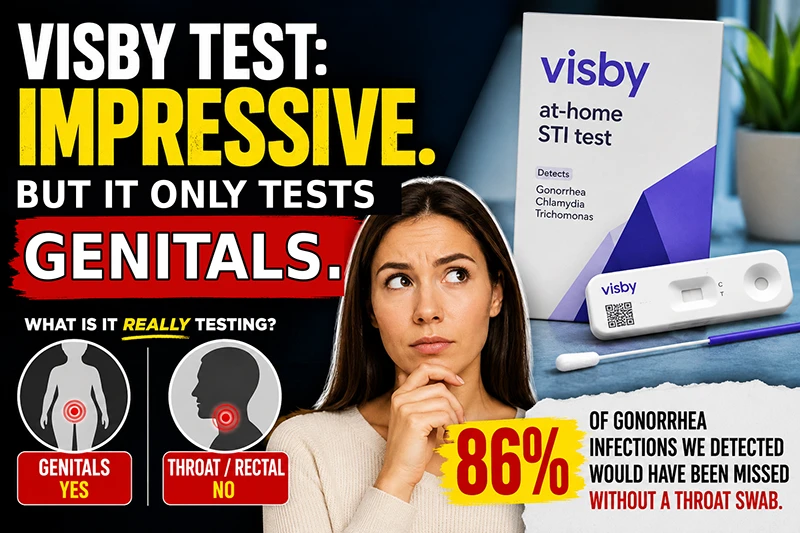
People purchase STI testing to find out whether or not they have an STI. So if somebody buys a test that says it checks for gonorrhea, chlamydia, and trichomonas, and they receive three negative results, they are naturally going to assume they do not have gonorrhea, chlamydia, or trichomonas. And that is precisely the concern with the Visby test.
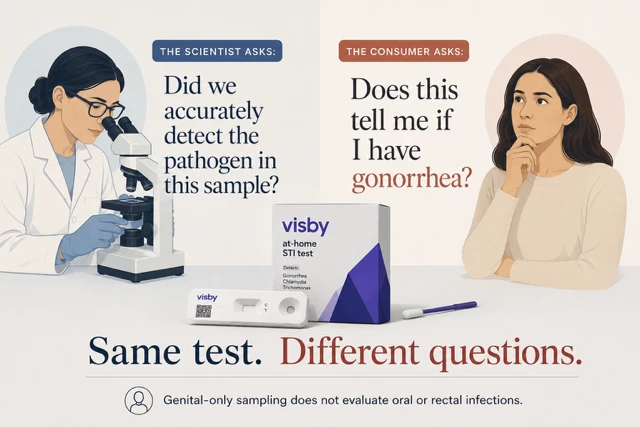
To be clear, the issue is not that the Visby test appears inaccurate. Scientifically speaking, it appears to perform extremely well at what it is designed to do. The concern is that it is currently limited to vaginal/genital testing.
That distinction matters enormously.
The Visby page advertises “~97% accuracy,” and that may very well be true for genital infections detected from vaginal samples. But that does not mean the test is 97% accurate at determining whether somebody has gonorrhea or chlamydia anywhere in their body.
Across multiple peer-reviewed multisite screening studies, oral gonorrhea infections were found more frequently than genital gonorrhea infections when asymptomatic patients were screened both orally and genitally. In Kent et al., oral gonorrhea prevalence exceeded genital prevalence 9.2% to 6.0%. In Assaf et al., oral prevalence exceeded genital prevalence 5.63% to 2.72%. But this is not just an oral gonorrhea issue. Oral and anal infections are prevalent with both gonorrhea and chlamydia.
Consumers are not asking whether the test is analytically accurate for vaginal gonorrhea. They are asking a much more practical question: “Do I have gonorrhea?”
And that is where the concern begins.
A person can receive a negative genital result, believe they are completely negative for gonorrhea or chlamydia, and still carry an oral infection capable of being transmitted during oral sex.
At Shameless Care, for example, among our recent gonorrhea-positive patients, 86% tested positive orally while their genital tests were negative.
None of this means the Visby test lacks value. Quite the opposite. Rapid, private, highly accurate home STI testing is an impressive technological advancement and will likely help many people discover infections they otherwise would not have known they had.
But consumers deserve to clearly understand what the test is actually evaluating. In our opinion, there would be little downside to more prominently explaining that the test is limited to vaginal/genital samples and does not evaluate oral or rectal infections. That additional context would help consumers make more informed decisions about their sexual health while still benefiting from the remarkable technology that companies like Visby have created.
⸻