

1
Item
$63.00
We don't sell. We educate.
Weekly science about sex, delivered to your inbox.
There are things happening in online ED sales every single day that many people seem to consider perfectly normal, yet I personally find disturbing.
I’m going to tell you about three of them.
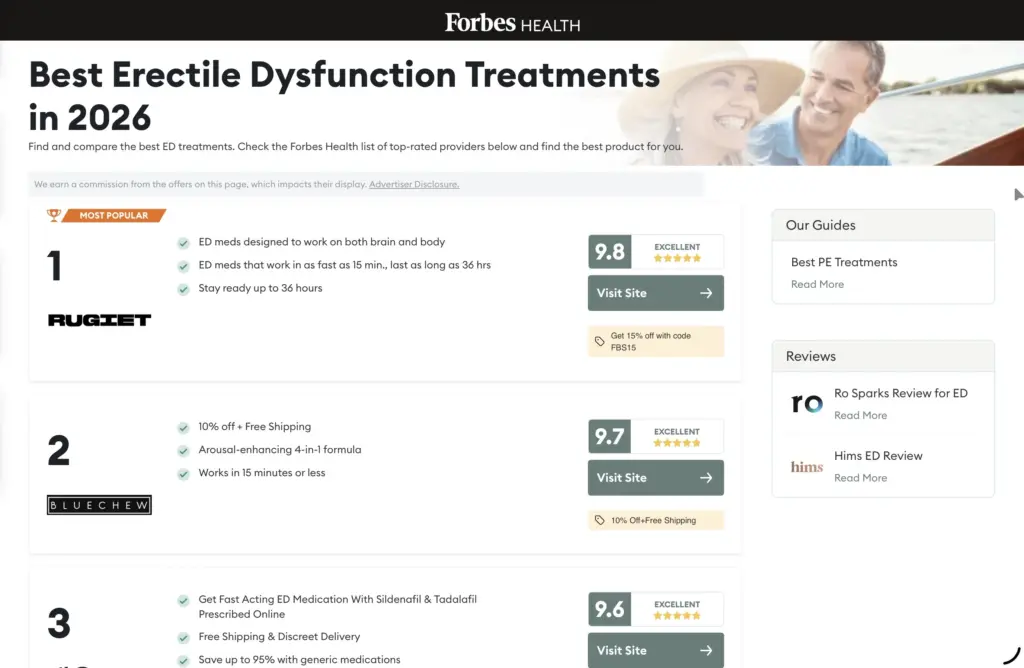
You’ve seen these.
“Best ED Treatments of 2026.”
Number one.
Number two.
Number three.
Usually on a major publication like Forbes.
And let’s be honest about what many consumers think when they land on that page.
They think:
Forbes tested all of these.
Forbes compared them objectively.
And Forbes concluded that number one is simply the best.
But then you read the disclosure.
It says Forbes earns a commission from offers on the page.
Not shocking.
But it also says compensation impacts display.
It says compensation influences ratings.
And it says compensation influences the order in which offers appear.
That changes everything.
Because now we’re no longer talking about a purely objective ranking.
We’re talking about a page where financial incentives are explicitly part of the ranking system.
And that’s my issue.
The headline says:
“Best Erectile Dysfunction Treatments of 2026.”
But a more honest headline might be:
“These are the ED treatments that financially benefit us the most.”
Of course, nobody would click that.
A lot of the marketing you see isn’t even coming directly from the company itself.
It’s coming from affiliates.
An affiliate is someone who earns a commission for generating sales for a company they do not own and do not work for.
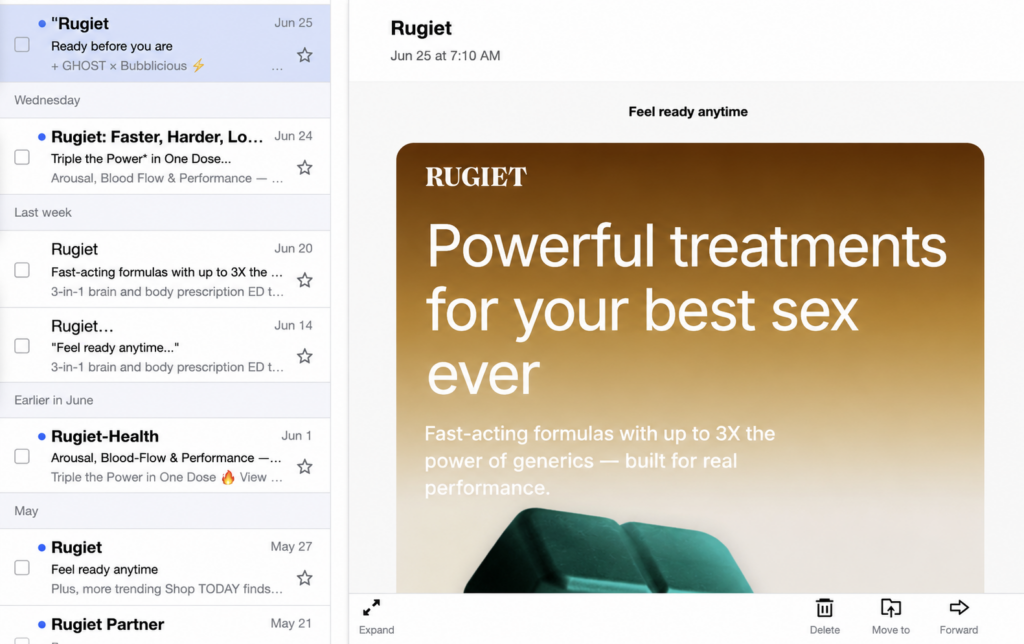
Look at these promotional emails I get in my personal inbox.
I never signed up for them.
And I can’t unsubscribe.
Why?
Because they aren’t all coming from the same sender.
These emails all look like they’re promoting the same brand.
But when I examine the sender addresses, I see:
crm@activewellnesscure.com
emails@bagitandtagitfast.com
hello@stronghealthcareplan.com
castlery@trendystoreonline.info
Those aren’t brand-owned domains.
They appear to be third-party senders.
That suggests affiliate-driven marketing.
And whether the company wrote the email or not, companies are ultimately responsible for the partners they choose to work with.
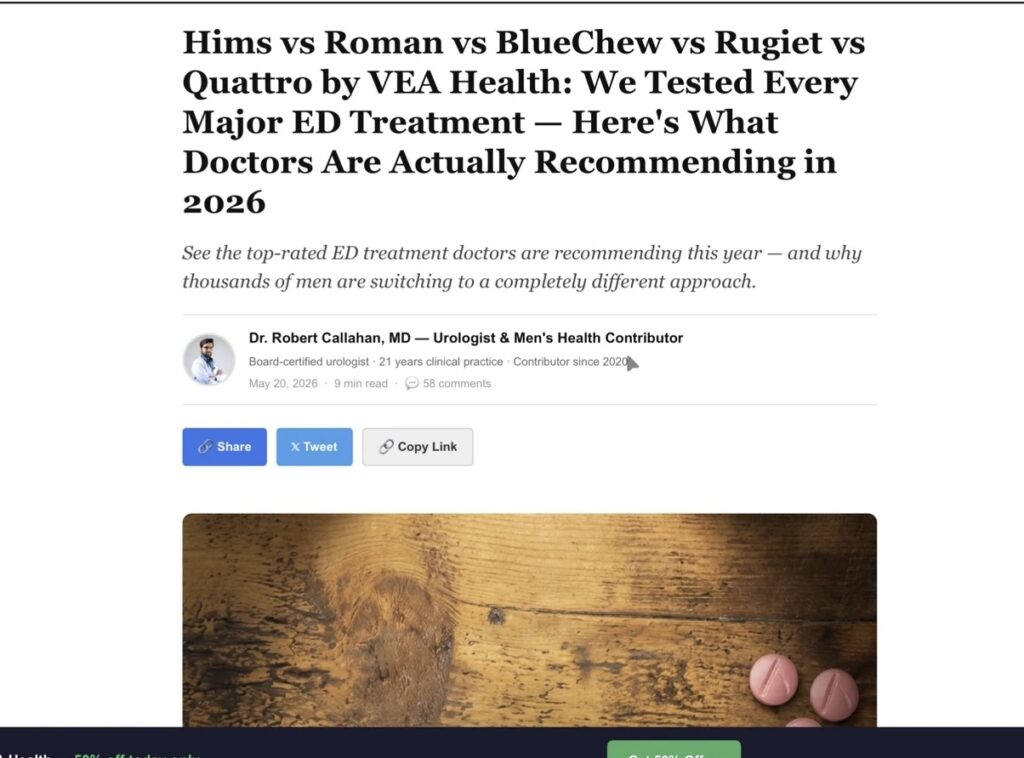
Advertorials are advertisements designed to look like journalism.
In this space, they’re everywhere.
They’re usually written from the perspective of someone presented as a real person.
Sometimes even a doctor.
Those people and doctors are usually fictitious.
In one case, I saw an advertorial written by someone presented as Dr. Robert McDonald, a board-certified urologist.
I reverse image searched the photo.
The image appeared to be a stock photo.
Maybe there’s an innocent explanation.
But when marketing materials use stock photography for people presented as real experts, that should raise questions.
I think part of my issue is that I just have a very old-school sense of morality.
If I’m not being completely honest, I’m uncomfortable.
If any part of what I’m doing is designed to mislead people, even a little bit, I don’t want to do it.
That mindset probably holds Shameless Care back in a lot of ways.
We grow slower.
We say no to things that other companies gladly say yes to.
But I think it also attracts a certain kind of customer.
Our customers are smart.
They ask good questions.
They pay attention.
They know when something feels manipulative.
And because of that, they trust us.
You can buy your way onto a listicle, you can buy affiliates, and you can buy advertorials, but you cannot buy real trust.