

0
Items
$0.00
We don't sell. We educate.
Weekly science about sex, delivered to your inbox.
For generations, most people thought herpes was simple.
HSV-1 caused cold sores.
HSV-2 caused genital herpes.
That was never completely true. Either type of herpes simplex virus can infect the mouth or the genitals.
But something much more interesting has happened over the past several decades.
Fewer Americans are acquiring HSV-1 during childhood.
That sounds like an obvious public-health win.
And in many ways, it is.
But it has also created an unexpected consequence.
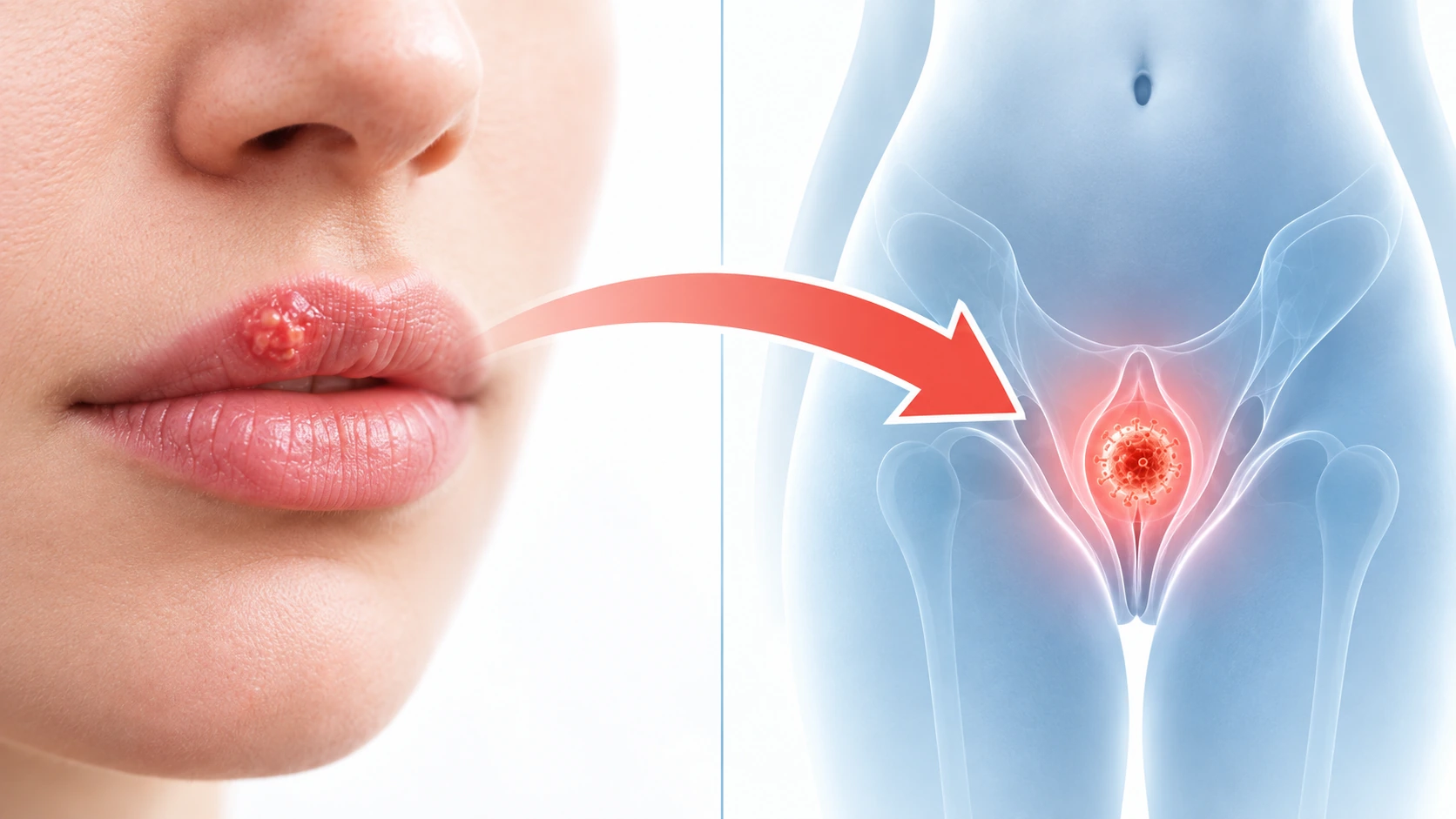
More people are reaching adulthood without HSV-1 antibodies. That means their first exposure to HSV-1 can happen during sexual activity, including oral sex.
The result?
HSV-1, the virus traditionally associated with cold sores, has become an increasingly important cause of genital herpes.
We call it:
Richard is a senior in college.
One night, after listening to the latest Guns N' Roses cassette, he hooks up with another college student.
His partner has oral HSV-1.
They have oral sex.
Richard, however, has already had HSV-1 for years.
Like many people of his generation, he acquired HSV-1 earlier in life and occasionally gets what everyone around him simply calls a cold sore.
He may not even realize that cold sores are caused by herpes simplex virus.
His immune system has already encountered HSV-1 and developed antibodies against it.

Now meet Richard Junior.
He's also a college senior.
He hooks up with another student who has oral HSV-1.
They have oral sex.
But Richard Junior is different from his father in one important way:
He's never had HSV-1.
If he is exposed to HSV-1 genitally during oral sex, that exposure can become his first HSV-1 infection.
And that first infection can occur on the genitals.

The sexual behavior didn't necessarily become riskier.
The population changed.
More young adults today reach sexual maturity without already having HSV-1.
One of the biggest misconceptions about herpes comes from the names we've traditionally given these infections.
HSV-1 became known as oral herpes.
HSV-2 became known as genital herpes.
But viruses don't follow those labels.
HSV-1 can infect the mouth.
HSV-1 can also infect the genitals.
HSV-2 is much more strongly associated with genital infection, although it can infect other locations as well.
So when someone says they have "genital herpes," that description alone doesn't tell you which virus they have.
They could have genital HSV-1.
They could have genital HSV-2.
And that distinction can matter.
Researchers have documented a substantial decline in HSV-1 infection among younger Americans.
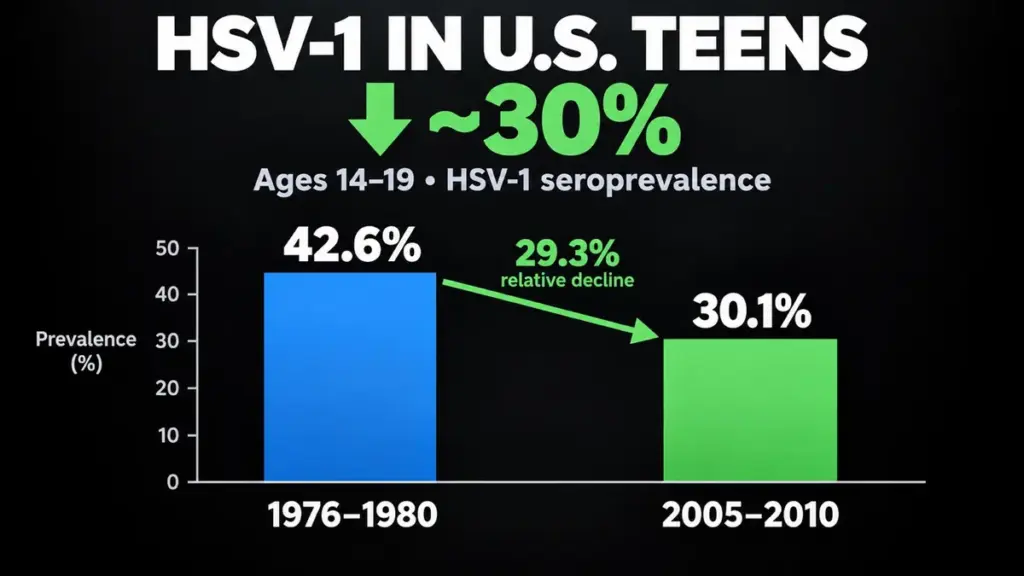
Among Americans ages 14 to 19, HSV-1 antibody prevalence declined from 42.6% in 1976-1980 to 30.1% in 2005-2010.[1]
That's a relative decline of more than 29%.
A large 2024 systematic review found the same overall trend.
Researchers reviewed 159 publications examining HSV-1 in the United States and concluded that HSV-1 prevalence has been declining over time.[2]
The researchers estimated that HSV-1 seroprevalence was declining by approximately 1% per year across the studies they analyzed.[2]
Why?
There probably isn't one single explanation.
Changes in living conditions, hygiene, household transmission patterns, family size, socioeconomic conditions, and other factors may all contribute.
But the consequence is important:
More teenagers are reaching sexual activity without already having HSV-1 antibodies.
That gives HSV-1 another opportunity.
Instead of being acquired orally earlier in life, the virus can sometimes be acquired later through sexual contact.
Imagine someone has oral HSV-1.
They may occasionally get cold sores.
Or they may have no visible symptoms at all.
HSV-1 can sometimes be shed from the mouth even when an obvious cold sore isn't present.
If that person performs oral sex on a partner who has never previously acquired HSV-1, the virus can potentially be transmitted to the partner's genitals.
The result is:
Genital HSV-1.
This isn't a new ability that HSV-1 suddenly developed.
HSV-1 has always been capable of infecting genital tissue.
What has changed is the number of people reaching adulthood without previously acquiring HSV-1.
And researchers can actually see that change in the data.
In 2003, researchers published a study examining newly diagnosed genital herpes infections among college students at the University of Wisconsin-Madison.
They reviewed genital herpes isolates collected from 1993 through 2001.[3]
In 1993:
31% of newly diagnosed genital herpes infections were caused by HSV-1.
By 2001:
78% were caused by HSV-1.[3]
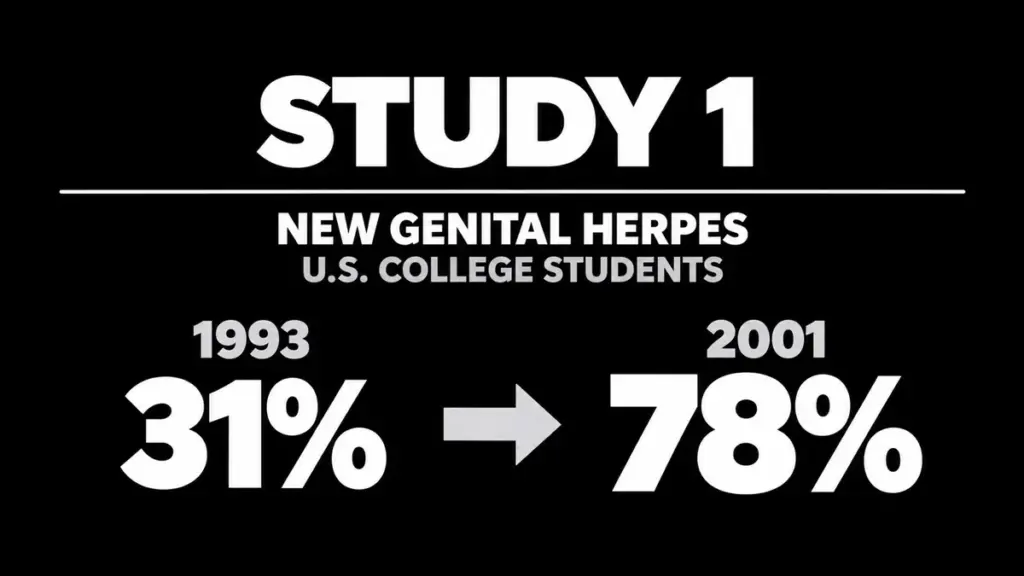
That's an extraordinary change in less than a decade.
In this specific college population, HSV-1 had become the most common cause of newly diagnosed genital herpes.
But researchers weren't finished.
Researchers later returned to genital herpes testing from the University of Wisconsin-Madison student health system.
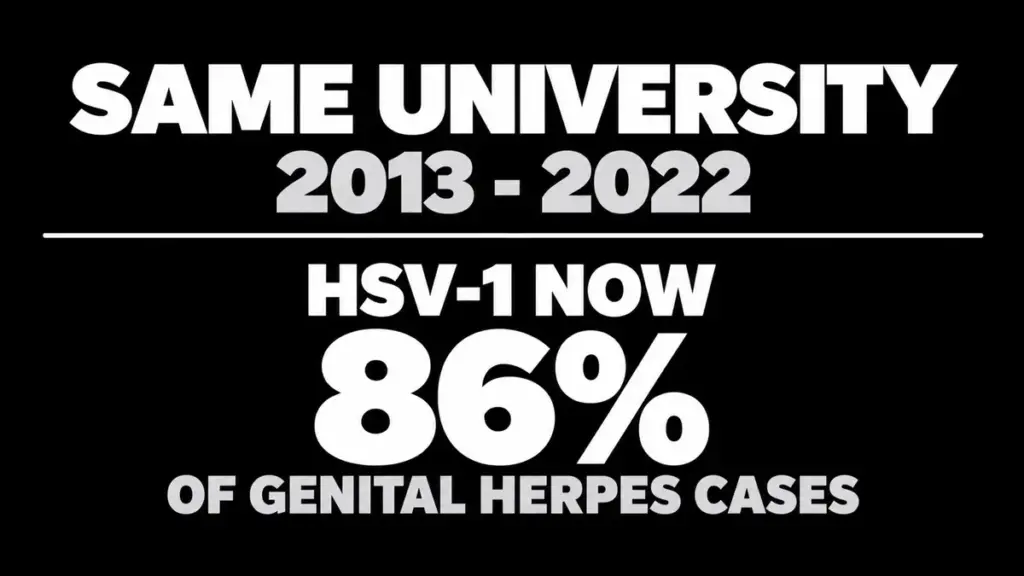
This time, they examined positive anogenital HSV PCR tests obtained from undergraduate and graduate students between 2013 and 2022.[4]
There were 691 positive HSV tests.
Of those:
600 were HSV-1.
That's:
86.8% of the positive genital HSV tests in this college-health population were HSV-1.[4]
Think about what that means.
In this population, the overwhelming majority of positive genital herpes tests were not HSV-2, the virus most people still associate with the phrase genital herpes.
They were HSV-1.
The virus most people associate with cold sores.
The broader scientific literature points in the same direction.
A 2024 systematic review and meta-analysis examined 159 publications describing HSV-1 epidemiology in the United States.[2]
Researchers identified:
They found two major trends:
HSV-1 prevalence is declining.
At the same time:
HSV-1 is becoming a larger contributor to genital herpes.
Their analysis estimated that the proportion of genital herpes involving HSV-1 was increasing by approximately 2% per year across the available studies.[2]
The researchers described the epidemiology as shifting away from HSV-1 being acquired predominantly orally during childhood and toward greater genital acquisition during adulthood.[2]
That's the Great Herpes Migration.
The virus didn't literally migrate.
The timing and location of people's first infections changed.
Part of what makes this subject confusing is cultural rather than scientific.
We created very different emotional meanings for similar infections depending on where they appear.
A blister on someone's lip?
We call it a cold sore.
An HSV infection involving someone's genitals?
We call it herpes.
But a cold sore caused by HSV-1 is herpes.
That doesn't mean cold sores should suddenly become frightening or shameful.
Quite the opposite.
Understanding how incredibly common HSV infections are should help reduce some of the stigma surrounding genital herpes.
The important lesson is simply this:
Oral HSV-1 can be sexually transmitted to the genitals.
Getting genital HSV-1 does not necessarily mean someone will experience the same long-term pattern they would with genital HSV-2.
Both viruses can cause genital outbreaks.
Both establish persistent infections in the nervous system.
Both can sometimes be transmitted when no visible outbreak is present.
But genital HSV-1 generally tends to reactivate and shed less frequently than genital HSV-2.
That means someone diagnosed with genital herpes should ideally know which type they have, rather than simply being told that they "have herpes."
The location matters.
The virus type matters.
And the type of test matters.
This is where the story requires a little nuance.
Prior HSV-1 infection produces an immune response that changes what happens during future exposure to the same virus.
That is one reason researchers believe declining childhood HSV-1 exposure may help explain the increasing importance of genital HSV-1.
However, having oral HSV-1 should not be interpreted as an absolute guarantee that genital HSV-1 could never occur.
Human biology is rarely that simple.
The more scientifically accurate way to think about the population trend is:
People who reach sexual activity without previously acquiring HSV-1 have an opportunity for their first HSV-1 infection to occur genitally.
As that population has grown, genital HSV-1 has become increasingly important.
Oral sex generally has a different risk profile from vaginal or anal intercourse.
For some infections, transmission risk may be considerably lower.
For others, oral sex is a very real route of transmission.
Herpes is one of them.
HSV-1 can move from the mouth to the genitals during oral sex.
Other infections, including gonorrhea and syphilis, can also be transmitted through oral sexual contact.
So:
Safer does not mean risk-free.
Understanding the actual routes of transmission allows people to make informed decisions without pretending that every sexual activity carries the same level of risk.
If you develop a new genital blister, ulcer, or suspicious lesion, getting that lesion tested while it is present is generally more useful than trying to diagnose herpes based on appearance alone.
Testing material directly from a lesion can determine whether herpes simplex virus is present and can often distinguish between:
HSV-1
and
HSV-2
That's useful information because genital HSV-1 and genital HSV-2 can behave differently over time.
Blood testing is a different question.
HSV blood tests look for antibodies rather than testing a genital lesion directly.
A positive HSV-1 blood test generally cannot tell you where the infection is located.
Someone with a positive HSV-1 antibody test may have acquired oral HSV-1 years earlier.
That test alone cannot tell you whether the infection is oral or genital.
For decades, HSV-1 and HSV-2 were mentally placed into two neat boxes:
HSV-1 = mouth
HSV-2 = genitals
Biology was never quite that simple.
And modern epidemiology has made those old labels even less useful.
Fewer young Americans are acquiring HSV-1 during childhood.
More are reaching sexual maturity without HSV-1 antibodies.
Some then encounter HSV-1 for the first time through sexual contact, including oral sex.
And when that happens, their first infection can occur genitally.
That's how the virus famous for causing cold sores became responsible for:
of positive genital HSV tests in one modern college-health population.[4]
Not because HSV-1 suddenly changed.
Because we did.
Too many people never get the sexual healthcare they need, and they aren't even aware of it.
Shameless Care connects people with judgment-free doctors, custom medications, and comprehensive labs right on their phone, so they can have the confidence to fully enjoy their sex lives.
No subscriptions. No awkward waiting rooms.