

0
Items
$0.00
We don't sell. We educate.
Weekly science about sex, delivered to your inbox.
At Shameless Care, we use the OraQuick HIV Self-Test in our at-home STI testing panels. But this test has some limitations that I believe everyone should understand.
I’m going to explain seven of those limitations, discuss the benefits of the test, and explain how FDA regulations have severely limited the HIV testing options available to at-home STI testing companies like Shameless Care.
But first, if you’ve landed on this page because you were searching the internet for information about OraQuick, I want to help you understand whether this is even the type of HIV testing you should be pursuing.
Let’s start with sensitivity.
Sensitivity is essentially how likely a test is to detect an infection when someone actually has it.
Think about a smoke detector.
A smoke detector with 100% sensitivity would detect every fire. A smoke detector with 90% sensitivity would detect nine out of ten fires, while potentially sitting there silently as the tenth house burns down.
The same principle applies to HIV testing.
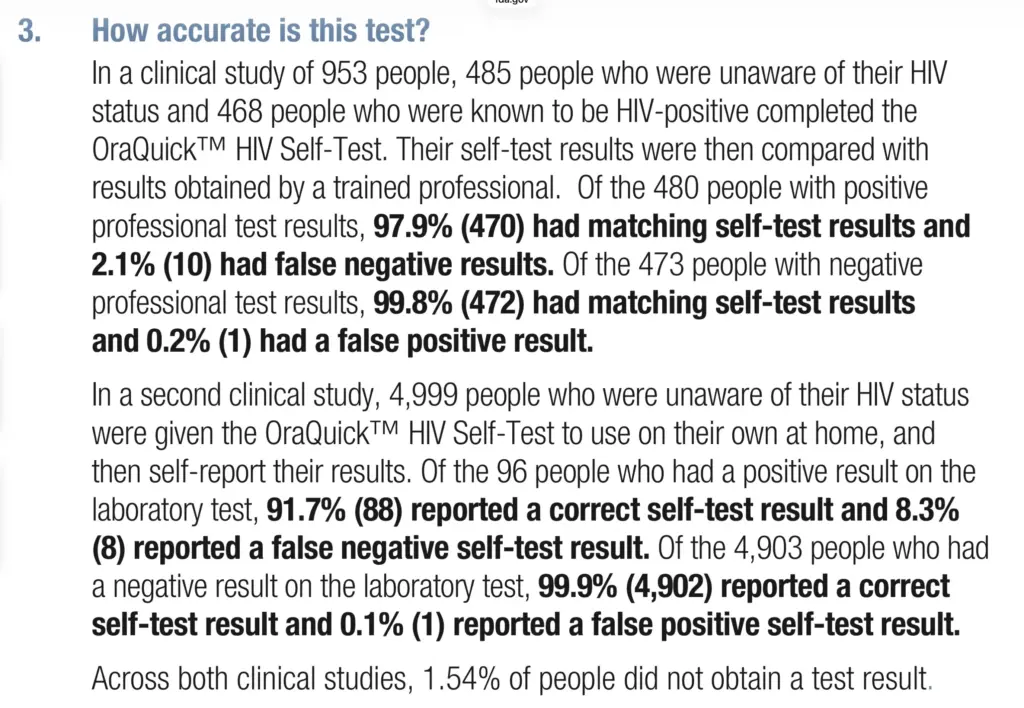
According to the FDA, the OraQuick at-home HIV test has an expected sensitivity of approximately 92%.1
In one clinical trial described in the manufacturer’s documentation, 96 people had HIV.
Those eight people actually had HIV, but the test told them they were negative.
That’s a significant limitation, particularly when compared with modern laboratory-based blood testing.
Now, this doesn’t mean that everyone who uses OraQuick has an 8% chance of getting the wrong result. It means that, among the people who actually had HIV in that particular clinical trial, approximately 8% received a false-negative result.
Those are very different things.
The FDA makes these performance figures publicly available, and I encourage anyone considering the test to read them.
This limitation is particularly frustrating to me.
PrEP, or pre-exposure prophylaxis, is medication that people take to prevent HIV infection.
We have plenty of patients at Shameless Care who use HIV prevention medication.
But the OraQuick manufacturer’s instructions warn that people taking antiretroviral medication, including PrEP or PEP, may receive false results.2
And the CDC specifically recommends avoiding oral rapid HIV tests for routine PrEP screening because they are less sensitive than blood-based tests and may fail to detect recent infections.3
The CDC recommends laboratory-based testing, including antigen/antibody testing and HIV RNA testing when appropriate, for people taking PrEP.
Think about that.
We operate an at-home STI testing company. Some of our patients take HIV prevention medication. Yet FDA enforcement against unauthorized at-home blood collection kits has pushed companies like ours toward an HIV self-test that isn’t recommended for routine PrEP monitoring.
That is difficult for me to reconcile.
If you’re taking PrEP, please do not rely on OraQuick as your only method of HIV screening. Work with your PrEP prescriber to obtain the recommended laboratory testing.
The next limitation is the window period.
A window period is the amount of time between acquiring an infection and when a test can reliably detect it.
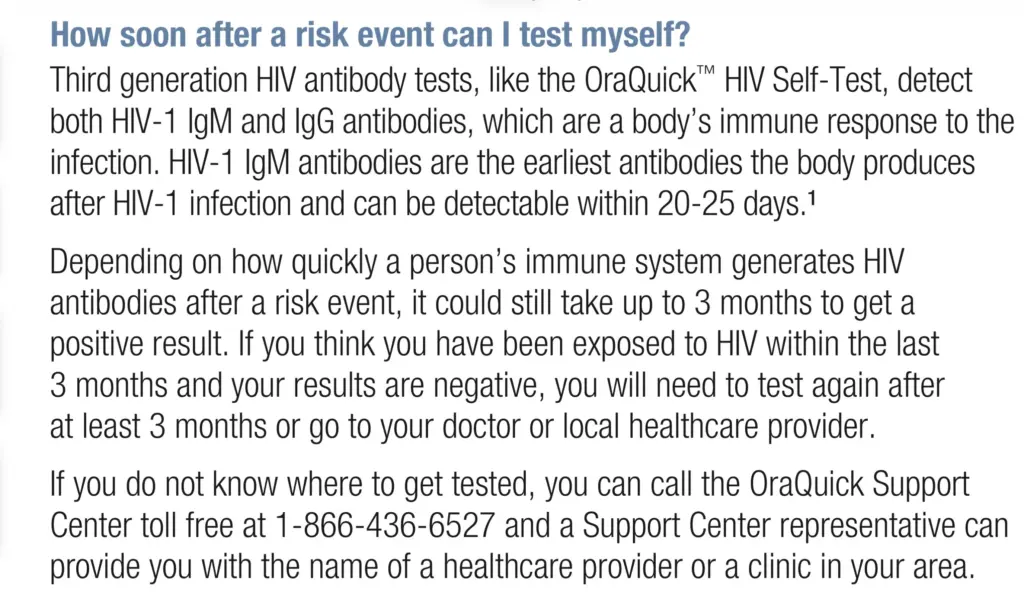
OraQuick detects antibodies to HIV. Your body needs time to produce those antibodies at detectable levels.
The manufacturer’s instructions warn that OraQuick may not detect an infection acquired within the previous three months.
Compare that with other HIV testing methods:
HIV testing method CDC window period
HIV RNA nucleic acid test (NAT) 10–33 days
Laboratory antigen/antibody blood test from a vein 18–45 days
Antibody test, including oral self-tests 23–90 days
These estimates generally apply in the absence of antiretroviral medications, which can affect detection.
So someone who had a potential HIV exposure four weeks ago might obtain a negative OraQuick result even though they have HIV.
A laboratory-based fourth-generation antigen/antibody test can typically detect HIV considerably sooner.
This is one reason I generally prefer laboratory blood testing for HIV when it is available.
Source: CDC: HIV Testing Methods and Window Periods4
OraQuick is designed to be used by ordinary consumers at home.
You swab your gums, place the device into a testing solution, wait approximately 20 minutes, and read the result.
Sounds simple enough.
But there’s an obvious problem.
What happens when someone sees a very faint line? Or something that looks like a line but might not be? Or they aren’t sure whether they followed the directions correctly?
Search Reddit for OraQuick and you’ll find people experiencing significant anxiety over their results.
Some post photographs of their testing devices and ask strangers on the internet whether they have HIV.
I can certainly understand their anxiety.
The manufacturer’s instructions explain that even a faint, complete test line can indicate a preliminary positive result requiring confirmation.
OraQuick does provide a consumer support line, which is helpful.
But I also think we need to acknowledge something important: Many people purchasing an HIV-specific test are already anxious about a potential exposure.
Giving someone a device they have to interpret themselves, without immediate access to a healthcare professional, can sometimes make that anxiety worse.
And a positive OraQuick result is not a confirmed HIV diagnosis. It requires follow-up testing by a healthcare professional.
Source: FDA: OraQuick HIV Self-Test Instructions and Package Insert
This is a limitation that most people probably haven’t considered.
At Shameless Care, we don’t participate in the specialized testing databases used by adult performers to verify their health status before working with other performers.
But some at-home testing companies do serve this industry.
Traditionally, laboratory-based testing produces a documented result that can be incorporated into a verification system, with appropriate authorization.
OraQuick works differently.
A person performs the test at home and sees the result on the device themselves. There is no laboratory processing the sample, and no automatically generated laboratory result.
That creates an obvious verification problem.
How do you independently establish that the test was performed by the person claiming the result? How do you establish when it was performed? How do you verify the result itself?
A photograph of a negative OraQuick device isn’t equivalent to a laboratory-generated test result tied to a verified specimen.
This matters in an industry where reliable, documented STI screening is an important part of occupational health.
And here’s where the FDA enters the picture.
In 2026, the FDA issued warning letters to companies offering at-home HIV blood sample collection kits without FDA marketing authorization.5
Those enforcement actions have created significant pressure on providers offering laboratory-based HIV testing with self-collected samples.
In my view, moving from documented blood-based HIV screening to an unsupervised oral self-test can create real disadvantages for this particular industry.
For example, the FDA’s March 17, 2026 warning letter to 4U Health explicitly addressed the company’s HIV dried blood spot self-collection kits.
Source: FDA: Warning Letter to 4U Health, March 17, 2026
This limitation isn’t necessarily a flaw in the device itself. It’s a problem with how some people approach sexual health.
HIV is an important infection, and everyone should understand their risk and testing options.
But HIV is not the only sexually transmitted infection.
I regularly encounter people online who are extremely anxious about HIV.
Some have purchased multiple OraQuick tests following the same potential exposure.
Two tests. Three tests. Five tests. Sometimes even more.
Meanwhile, when you ask about the rest of their sexual health, you sometimes discover that they aren’t being screened appropriately for gonorrhea, chlamydia, or syphilis.
They may not be vaccinated against HPV or hepatitis B.
They may never have heard of oral or anal swab testing.
And that’s a problem.
The probability of acquiring HIV depends heavily on the type of exposure and other circumstances. For many sexual exposures, bacterial STIs are substantially more likely than HIV.
Someone can spend weeks worrying about a potential HIV infection while completely overlooking an asymptomatic gonorrhea infection that they are actively transmitting to other people.
I would much rather see someone work with a knowledgeable healthcare professional to determine which infections they should be tested for, which anatomical sites need testing, and when testing should occur.
That is generally a better approach than choosing your own adventure from the pharmacy shelf.
To be clear, I’m not suggesting that HIV self-testing is bad or that people shouldn’t use it.
I’m suggesting that an HIV test is not a comprehensive sexual health screening.
The CDC recommends STI screening based on a person’s sexual history, sexual practices, and individual risk factors.
Source: CDC: STI Screening Recommendations
Here’s another limitation that most consumers probably never consider.
HIV is a reportable infection in the United States.
When an HIV diagnosis is confirmed through the traditional healthcare system, laboratories and healthcare professionals have reporting responsibilities under applicable state laws.
That information ultimately helps public health authorities monitor HIV diagnoses, understand trends, and allocate resources.
But OraQuick is a private, at-home self-test.
Someone can buy it at a pharmacy, perform the test at home, and receive a preliminary positive result without any healthcare professional or laboratory knowing about it.
The test doesn’t automatically report that result to anyone.
If the individual follows up with a healthcare professional and receives a confirmed diagnosis, that diagnosis can then enter the public health reporting system.
But what if they don’t?
What if they simply throw away the test?
Public health authorities may never learn about the result.
This doesn’t mean that private HIV testing shouldn’t exist. Confidentiality and privacy are important reasons people choose self-testing.
But it does illustrate a tradeoff between completely private testing and the public health benefits of clinical follow-up, confirmed diagnoses, and disease surveillance.
Source: CDC: HIV Surveillance
Absolutely.
Despite everything I’ve written, I can appreciate several benefits.
First, OraQuick allows people to test themselves privately without visiting a healthcare facility.
For some people, that is an enormous advantage.
There are undoubtedly individuals who would never voluntarily walk into a clinic for an HIV test but are willing to purchase one from a pharmacy.
If someone discovers a potential HIV infection through OraQuick, obtains confirmatory testing, and starts treatment, that is a public health success.
I also appreciate that OraQuick is FDA approved.
That means the manufacturer was required to submit evidence supporting the test’s safety and effectiveness.
We can look up actual clinical performance data.
We can examine its sensitivity and specificity.
We can identify its known limitations.
And we don’t have to rely on vague marketing statements about a test being highly accurate or working incredibly fast.
Those are meaningful benefits.
My criticism isn’t that OraQuick should never be used.
My criticism is that OraQuick is not the best HIV testing method for everyone, yet FDA regulations have severely limited some of the alternatives available to at-home testing companies.
Source: FDA: Information Regarding the OraQuick In-Home HIV Test
Here’s where things get interesting.
For years, at-home STI testing companies have used self-collected samples that are mailed to laboratories.
A patient might collect a urine sample, throat swab, anal swab, or small blood sample at home.
Those specimens are then analyzed by a laboratory.
This is how Shameless Care provides comprehensive testing without requiring someone to travel to a physical clinic.
One method of collecting blood at home involves a dried blood spot card.
A patient pricks their finger, places a few drops of blood onto specially designed collection paper, lets it dry, and mails it to a laboratory.
There is substantial scientific research supporting the use of dried blood spot specimens for certain HIV testing applications when the collection, handling, and laboratory methods have been properly validated.
But there is an important regulatory distinction.
The fact that a laboratory can accurately analyze a dried blood spot specimen does not automatically mean that a particular at-home collection kit has received FDA authorization for that use.
And the FDA has been aggressively enforcing that distinction.
In October 2024, the FDA published a safety communication warning that HIV blood sample self-collection kits were being marketed without the required authorization.
The agency specifically stated that it had not authorized any self-collection kits for obtaining blood samples, including dried blood spots, for HIV testing.
The FDA also expressed concerns about proper sample collection, transportation, and specimen stability.
Source: FDA: Important Information on Unapproved HIV Blood Sample Self-Collection Kits
In 2026, the agency followed up with additional warning letters.
One example was the March 17, 2026 warning letter to ProDX, which sells STI testing to adult performers.
The agency determined that the company’s HIV dried blood spot collection kit was being marketed without the required authorization and described it as an adulterated and misbranded medical device under federal law.
The FDA explicitly warned that failure to correct the violations could result in seizure, injunctions, or civil monetary penalties.
These were not casual suggestions.
They were formal regulatory enforcement actions.
And the FDA’s position isn’t that a laboratory becomes exempt from device regulations simply because a physician orders the test or interprets the results.
I understand the FDA’s concern.
A home collection kit needs to be evaluated for more than the laboratory’s ability to detect HIV. Sample collection, shipping conditions, stability, and the possibility of user error all matter.
Those are legitimate concerns.
But I also think we need to ask a bigger question.
Are we actually improving HIV testing by pushing providers away from laboratory-based blood testing and toward a self-administered oral test with a longer window period and lower sensitivity?
Especially when the CDC recommends against routinely using oral rapid tests for people taking PrEP?
That is the part I find so difficult to reconcile.
The FDA’s regulations have left providers like Shameless Care with limited authorized options for offering HIV testing entirely at home.
OraQuick is one of those options, which is why we include it in our panels.
But I don’t believe that means we should pretend it is the ideal HIV testing method for every patient.
I would like to see more at-home blood collection methods receive FDA authorization for HIV testing.
That includes dried blood spot collection systems supported by appropriate clinical validation, including evidence about collection quality, specimen stability, shipping, and analytical performance.
The technology deserves a clear regulatory pathway.
We shouldn’t have to choose between regulatory compliance and access to testing methods that may better meet the needs of particular patients.
Until additional collection methods are authorized, companies like ours have to operate within the regulatory options available.
And consumers deserve to understand exactly what those limitations are.
The FDA itself has acknowledged the need for additional authorized at-home HIV testing options and has expressed interest in working with manufacturers to bring more of these products to market.
My recommendation: What type of HIV test should you get?
If you’re simply looking for a convenient, private HIV screening option and your last possible exposure was more than three months ago, OraQuick may be a reasonable choice.
But if you’ve had a more recent exposure, I would generally recommend laboratory-based blood testing instead.
A fourth-generation antigen/antibody test performed on blood drawn from a vein can detect HIV substantially sooner than OraQuick.
If you’re taking PrEP, work with your prescribing clinician to obtain the recommended blood-based testing rather than relying on an oral self-test.
If you have a potential exposure within the last 72 hours, seek urgent medical advice about post-exposure prophylaxis (PEP). Don’t wait for an OraQuick test.
And regardless of which HIV test you choose, remember that HIV is only one part of sexual health.
Appropriate testing for gonorrhea, chlamydia, syphilis, and other infections matters too. Depending on your sexual activities, that may include throat and anal swabs, not just urine or blood testing.
At Shameless Care, our goal has always been to give people thorough STI testing, accurate information, and straightforward medical care.
Sometimes that means explaining why a test we actually offer isn’t necessarily the best choice for everyone.
I’d much rather tell you the truth about a product’s limitations than pretend those limitations don’t exist simply because we sell it.
Robert Johnson
Founder, Shameless Care