

0
Items
$0.00
We don't sell. We educate.
Weekly science about sex, delivered to your inbox.
The collection question, honestly answered — including where at-home testing actually falls short
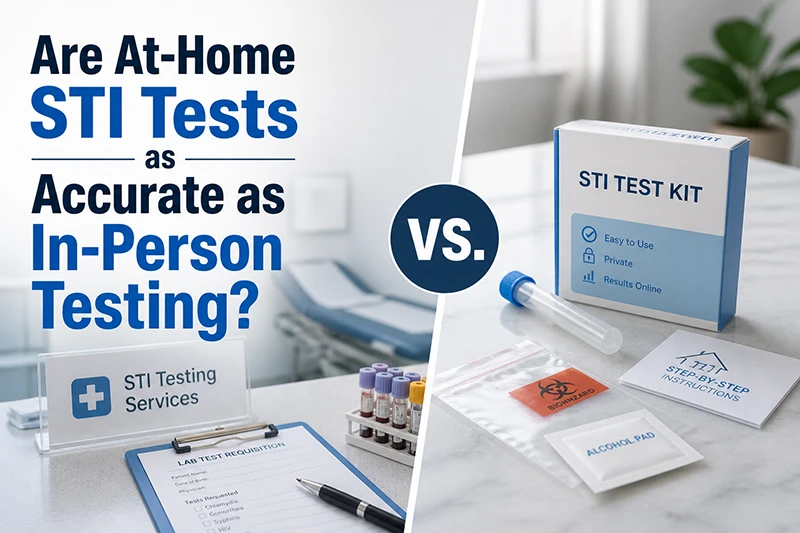
Self-collected STI samples are clinically equivalent to clinician-collected ones. So when someone online argues that in-person testing is “more accurate” because patients make mistakes at home, they are, charitably, answering the wrong question.
The real question isn’t who collected the sample. It’s what sites got tested. An at-home test that includes throat, rectal, urine, and blood samples will catch infections that a urine-and-blood-only in-person test fundamentally cannot — no matter how skilled the phlebotomist is.
And a urine-and-blood-only test is almost always what you get when an online testing service sends you to a local Quest or LabCorp. A phlebotomy center is set up to draw blood and hand out urine cups. It isn’t, in the direct-to-consumer workflow, set up to collect throat or rectal swabs. “Go to a real collection center for more accurate testing” is, in practice, a pitch for a less comprehensive panel than a well-designed at-home kit actually covers.
That matters because in every population where asymptomatic gonorrhea screening has been studied — heterosexual men, women, and MSM alike — pharyngeal infections show up at roughly double the rate of urogenital infections. The throat is where gonorrhea quietly lives. Urogenital infections in men tend to be symptomatic and get treated quickly, which keeps their point-prevalence low. The asymptomatic throat infection is the one sitting there waiting to be found.
Miss the throat and you miss most of the infections. That’s not a collection-technique problem. That’s a missing-the-infection problem.
⸻
There is an entire subreddit ostensibly dedicated to STI testing questions that is, in practice, moderated by affiliates of a specific online testing company. Whatever question a user arrives with, the answer is reliably the same product recommendation.
The argument that keeps surfacing from that ecosystem: in-person collection is more accurate because self-collection at home is too prone to mistakes. It’s usually deployed to steer readers toward a urine-and-blood-only service that does not include throat or rectal swabs at all.
The argument is wrong. Here’s the walk-through, specimen by specimen.
⸻
Pharyngeal gonorrhea lives in the oropharynx — the back of the throat, including the tonsils and the posterior pharyngeal wall. Not the roof of the mouth. Not the inside of the cheek.
This is the one specimen type where patient error at home is a real concern. A patient who doesn’t read the instructions could swab the wrong part of their mouth and get a falsely negative result. Our kit instructions direct the swab to the back of the throat, with visual guidance, for exactly this reason.
But compare the failure modes honestly:
An imperfect swab beats no swab. Always.
⸻
Simple procedure: insert one to two inches, rotate, done. Patient error is possible but uncommon.
And there’s a backstop. When the sample reaches the lab, it gets checked for adequacy before the assay is run. Andrea Mora, Ph.D., who oversees daily sample processing at our lab partner Nexus Labs, describes what that involves:
“The initial adequacy check happens during accessioning — sample receipt, logging, and initial inspection — where we take a quick but systematic look at whether the sample meets basic quality criteria. For swab samples, we’re asking a few questions: Is the tube intact? Is there a label, and can we read it? Is there actually a swab in the tube? And do we know when it was collected? These checks help confirm we’re working with the correct sample, that it hasn’t been compromised, and that it’s still within an acceptable timeframe for reliable results.”
If a sample fails those checks, it doesn’t get run. As Andrea puts it: “It is rejected during accessioning and documented in the laboratory information system with the specific reason for rejection. The lab does not proceed with testing that sample. The client is then notified, along with the reason and recommended next steps — typically requesting that the patient provide a new sample.”
Translation: you get a request to re-collect, not a false clean bill of health.
Same comparison as before: a urine-and-blood-only test can’t detect rectal infections at all. 100% miss rate, every time.
⸻
This one is almost funny. The at-home-versus-in-person distinction is meaningless — the physical steps are identical.
At a Quest or LabCorp: you’re handed a cup, you walk into a bathroom by yourself, you urinate into the cup, you cap it, you leave it in a pass-through window. At home with our kit: you’re mailed a cup, you walk into a bathroom by yourself, you urinate into the cup, you cap it, you put it in a prepaid mailer. I’ve personally done both. A bathroom is a bathroom.
⸻
For bloodborne infections — HIV, syphilis, hepatitis B, hepatitis C — the collection method genuinely differs.
In-person: a phlebotomist draws a tube of blood from your arm. It’s uncomfortable. It can be anxiety-inducing. But they do this dozens of times a day and rarely make a meaningful error — unless you’re the unlucky patient whose phlebotomist digs for a vein or puts the needle through the other side. Not pleasant, not horrifying.
At home: you prick your finger with a lancet and fill circles on a dried blood spot (DBS) card. The card dries, you mail it in, the lab extracts serum-equivalent samples for testing.
The common patient error here is under-filling — not enough blood on the card. And here’s where the “self-collection produces false negatives” argument collapses: an under-filled DBS card is rejected by the lab, not run and reported as negative.
Andrea explains the clinical reasoning behind that rejection:
“Underfilled DBS cards are rejected because they may not contain sufficient or representative sample for reliable testing. Our assays are validated using blood spots that are fully filled and saturated through both sides, meeting defined criteria — roughly 6 mm diameter. Samples that fall outside those specifications may not perform as expected. From a clinical standpoint, an underfilled spot increases the risk of a false negative due to insufficient analyte or uneven sample distribution. Rather than report a potentially inaccurate result, we reject these specimens to maintain assay integrity.”
How often does this actually happen? Across all sample types Nexus processed in 2025, the overall rejection rate was 0.82% — and every rejected sample triggers a re-collection request, not a false negative result.
In four years at ShamelessCare, the blood-collection failure mode I’ve seen is consistent: “not enough sample, please re-collect.” Never “falsely negative because of under-fill.” The lab simply doesn’t run the assay on a bad sample.
⸻
The “self-collection is unreliable” claim isn’t supported by the research either. Andrea points to a body of literature that’s accumulated over the past decade comparing self-collected to clinician-collected samples:
“Literature suggests that while self-collected samples can have slightly higher rejection rates compared to clinician-collected specimens, the difference is generally modest when proper instructions, packaging, and support are in place. With well-designed programs, self-collection can achieve sample quality comparable to clinician-collected samples.”
The systematic reviews and meta-analyses backing that conclusion are listed in the sources below.
⸻
To be straight with you about where at-home testing actually falls short: it isn’t collection technique. It’s the mail.
A specimen handed across a counter at a phlebotomy center is couriered to the lab the same or next day. A specimen collected at home travels through USPS or a private carrier. Most arrive on time. Some don’t. Packages are occasionally delayed. Packages are occasionally lost.
As I write this in mid-April, our lab partner just received a patient’s specimens that had been mailed in January — well outside the stability window, and therefore discarded. That’s a real cost, and it doesn’t happen when a sample is handed across a counter.
If mail reliability in your area is a serious concern, or you need results on a truly urgent timeline, a local clinic may be faster. For most people, for most scenarios, the mail works fine. I’m not going to pretend otherwise.
What I don’t accept is the idea that this mail risk outweighs the fundamental advantage of testing the sites where infections actually live. A delayed at-home sample that eventually arrives still tests throat, rectum, urine, and blood. A same-day urine-and-blood-only test at a phlebotomy center cannot detect pharyngeal or rectal infections — ever, under any circumstances, no matter how fast the courier.
⸻
When marketing affiliates argue that in-person collection is more accurate because patients make mistakes at home, they’re steering readers from a comprehensive panel toward a less comprehensive one. The accuracy framing is a distraction from the real question: is this test even looking in the right places?
Comprehensive at-home testing beats urine-and-blood-only in-person testing, every time. The reverse is a story told by affiliate marketers, not by the research.
⸻
McLaughlin SE, Golden MR, Soge OO, et al. Pharyngeal Gonorrhea in Heterosexual Male and Female Sex Partners of Persons With Gonorrhea. Sex Transm Dis. 2023;50(4):203–208.
Zneimer S, Hongo D, Sabalza M, Heckler I. Implementing Dried Blood Spot (DBS) Testing in the Clinical Laboratory. CLP, 2022.
Centers for Disease Control and Prevention. STI Screening Recommendations.
Parapob N, Lekawanvijit S, Tongsong T, Charoenkwan K, Tantipalakorn C. A comparative study of self-collected versus clinician-collected specimens in detecting high-risk HPV infection: a prospective cross-sectional study. Obstet Gynecol Sci. 2024;67(6):557–564.
Jiang TT, Cao NX, Luo W, et al. Performance and acceptability of self-collected specimens for diagnosis of rectal and pharyngeal Chlamydia trachomatis and Neisseria gonorrhoeae infections among men who have sex with men in China: a randomized controlled trial. BMC Infect Dis. 2024;24:1366.
Jaya ZN, Mapanga W, Dlangalala T, Thembane N, Kgarosi K, Dzinamarira T, Mashamba-Thompson TP. Accuracy of self-collected versus healthcare worker collected specimens for diagnosing sexually transmitted infections in females: an updated systematic review and meta-analysis. Sci Rep. 2024;14:10496.
Haddad MS, Bifulco L, McIntosh J, McClain Garcia M. Rectal specimen self-collection for chlamydia and gonorrhea screening: a cross-sectional feasibility study at a community health center. Pilot Feasibility Stud. 2021;7(1):208.
Taylor D, Lunny C, Wong T, et al. Self-collected versus clinician-collected sampling for sexually transmitted infections: A systematic review and meta-analysis protocol. Syst Rev. 2013;2:93.