

0
Items
$0.00
We don't sell. We educate.
Weekly science about sex, delivered to your inbox.
PrEP is a medication that prevents HIV.
The original brand-name oral PrEP developed by Gilead Sciences is now available as an inexpensive generic. When taken consistently, it reduces the risk of getting HIV from sex by approximately 99%.
But Gilead has developed a new medication called Yeztugo, an injection that provides six months of HIV prevention.
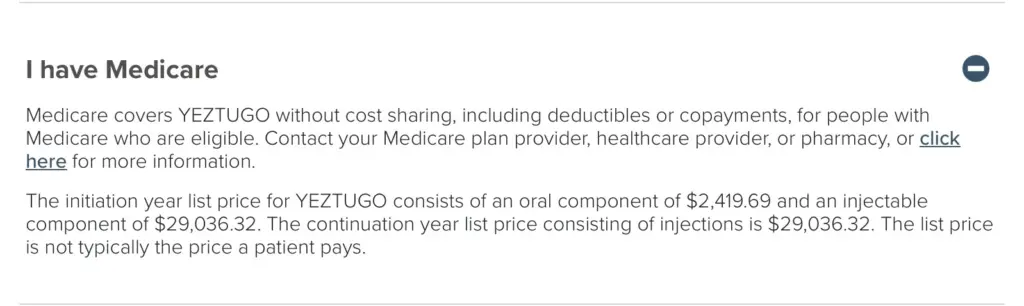
And its annual list price is approximately $29,000.
First, I Have Enormous Respect for Gilead
Gilead has made extraordinary contributions to HIV treatment and prevention. Its medications have transformed HIV from a frequently fatal disease into a manageable chronic condition for millions of people.
And Yeztugo is another remarkable medical achievement.
I have absolutely no criticism of Gilead for developing an effective medication or making people aware of it.
My concern is with a healthcare system where a medication costing $29,000 annually can become the solution to a problem that already has a $350 solution, or may not require medication at all.
Let’s look at how that happens.
Likely no one would pay that much.
But luckily, they don’t have to.
According to Gilead’s May 2026 investor report, approximately 95% of insured Americans had coverage for Yeztugo, and 95% of those covered could access it with a $0 copay.
Now consider how this works.
A woman sees an advertisement from Gilead encouraging her to be responsible about her sexual health and talk to her doctor about these injections.
She thinks, “Okay, this is what a responsible woman would do.”
She asks her doctor about it.
Her doctor writes a prescription.
Her insurance company pays Gilead.
The patient probably never had any idea that her insurance company paid $14,000 to $29,000 per year* for these injections.
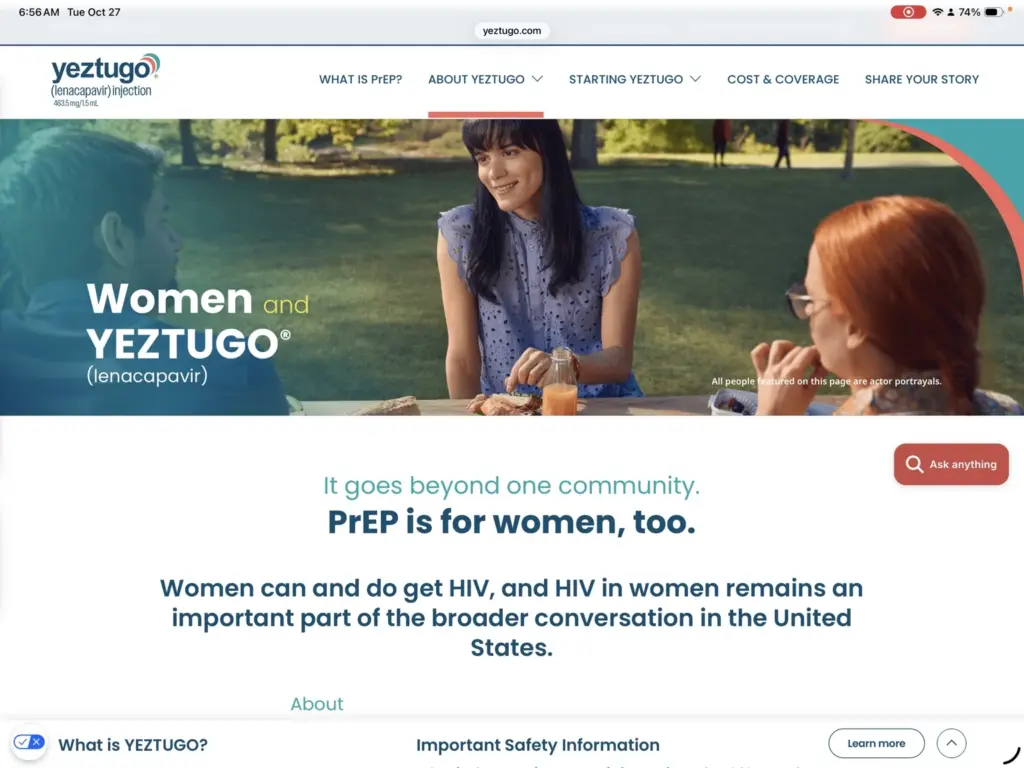
Gilead's website educating women about PrEP is heavily focused on the injections.
Part of the answer involves the Affordable Care Act, also known as Obamacare, and a government advisory group called the United States Preventive Services Task Force, or USPSTF.
When this group gives a preventive healthcare service an A rating, most health insurance plans generally must cover that service without charging deductibles or copays, under certain rules.
PrEP received an A rating for men and women at increased risk of HIV.
And one of the criteria for considering PrEP in women is particularly broad:
A history of inconsistent or no condom use with sexual partners whose HIV status is unknown.
In plain English, that means sometimes having sex without a condom with someone whose HIV status you don’t know.
But here’s something even more interesting.
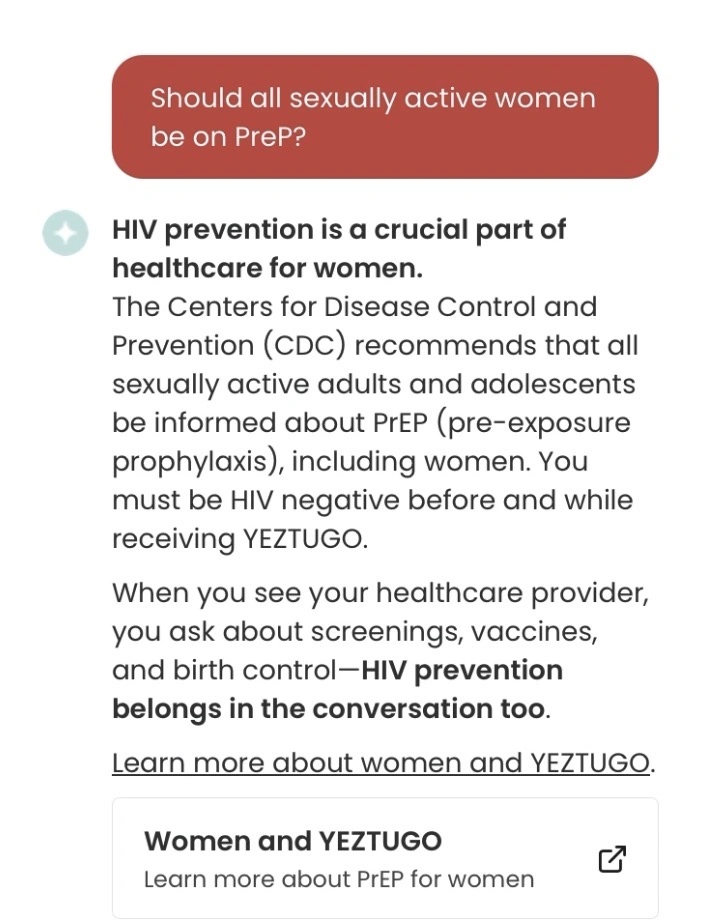
The CDC tells physicians to prescribe PrEP to anyone who asks for it, even if they don’t report any HIV risk factors.
And in August 2026, the American College of Obstetricians and Gynecologists issued a similar recommendation.
Think about that.
A woman doesn’t even have to report substantial HIV risk to be considered for PrEP. Her physician is being encouraged to prescribe it simply because she asks.
These recommendations apply to PrEP generally, not specifically to Yeztugo. But Gilead is promoting the injection in an "educational" resource for women about PrEP (see the image above), so women are likely to ask their doctor about the injection specifically.
According to the CDC, approximately 7,752 women were diagnosed with HIV in 2024. In comparison, about 25,129 HIV diagnoses were linked to sex between men.
HIV affects gay and bisexual men at much higher rates, partly because HIV spreads more easily through anal sex than vaginal sex.
Here are the CDC’s estimated risks from a single episode of sex without a condom with someone who has HIV that can be passed to another person.
Type of sex Estimated HIV infections per 10,000 exposures
Receiving vaginal sex 8
Giving vaginal sex 4
Giving anal sex 11
Receiving anal sex 138
For a woman having vaginal sex with a man who has transmissible HIV, the estimated risk is 8 in 10,000, or 0.08%, each time they have sex.
That’s not zero, but it’s relatively low.
And remember, that number assumes her partner actually has HIV that can be transmitted.
Women who have receptive anal sex face a much greater risk. One mathematical model estimated that nearly 40% of HIV infections among heterosexual women ages 18–34 were associated with anal intercourse.
That’s an estimate, not a count of confirmed transmission events.
The point is simple.
Not every sexually active woman faces the same risk of HIV.
Different communities. Different sexual histories. Different sexual practices. Different partners.
These differences matter when deciding who needs HIV prevention medication.
Yeztugo has an important advantage over generic oral PrEP.
Patients don’t have to remember to take a pill every day.
For someone at substantial risk of HIV who struggles to take daily medication, that could be life-changing.
Consider someone experiencing homelessness, living in crisis, or facing circumstances that make maintaining a daily medication routine difficult.
Six months of protection without remembering a daily pill could be tremendously valuable.
Now consider someone with very little HIV risk who has no difficulty taking a daily tablet.
Generic PrEP may provide all the protection that person needs, at a fraction of the cost.
And in some cases, a person’s HIV exposure risk may be so low that preventive medication isn’t medically necessary.
Here’s what I’d like to know.
How many women receiving Yeztugo have substantial HIV exposure risk or difficulty taking daily medication? And how many could do just as well with generic PrEP?
We don’t have enough information about who’s receiving these prescriptions to answer that question.
But it’s an important question when the treatment carries a $29,000 annual list price.
This is what bothers me about our healthcare system.
A pharmaceutical company develops an effective medication.
A physician prescribes an approved treatment.
An insurance company pays for it.
And a patient receives medication that may cost her nothing.
Everyone can be acting appropriately.
But that doesn’t automatically mean we’re spending healthcare dollars wisely.
Did the patient need a $29,000 injection instead of a $350 generic tablet?
Did she need PrEP at all?
HIV isn’t exclusively a disease affecting gay and bisexual men. Women can and do acquire HIV.
But does that mean every sexually active woman needs PrEP?
Should HIV prevention medication become as common as birth control?
These are questions worth asking.
Like so many things in healthcare, it’s easy to say, “Well, the risk isn’t zero, so let’s prescribe something.”
But if we try to eliminate every possible risk, regardless of how small it is or how much prevention costs, we eventually create a healthcare system nobody can afford.
And frankly, we already have an extraordinarily expensive healthcare system.
The United States spends more on healthcare per person than any other wealthy country, yet Americans have some of the shortest life expectancies among them.
That’s not Gilead’s fault. And it’s certainly not the fault of patients who want to protect themselves.
It’s a larger question about how we decide which treatments are worth paying for and how we make those decisions.
Public health isn’t about eliminating every possible risk at any cost. It’s about making the greatest possible improvement in health with the resources we have.
⸻
Insurance companies negotiate pricing with Gilead. Actual payments vary by insurer and agreement. The $29,000 figure is the manufacturer’s annual list price, while lower reported figures reflect certain negotiated payments and provider reimbursements.
Sources and Further Reading